In shortDamnoen Saduak vs Amphawa comes down to the day and the hour. Damnoen Saduak trades every morning, 80 to 100 km southwest in Ratchaburi, and the stretch worth the drive runs roughly 07:00 to 09:30. Amphawa lies about 50 km out in Samut Songkhram and opens Friday to Sunday, 2 pm to 9 pm on its own site, with grilled-seafood boats serving from midday into the evening.
80 to 100 kmBangkok to Damnoen Saduak
about 50 kmBangkok to Amphawa
07:00 to 09:30Damnoen Saduak's best hours
2 pm to 9 pmAmphawa, Friday to Sunday
Damnoen Saduak vs Amphawa: the short answer
The calendar decides this before you do. Four days out of seven the comparison is settled for you: the official Amphawa site puts trading on Friday, Saturday and Sunday, 2 pm to 9 pm, and leaves Monday to Thursday blank. Damnoen Saduak trades every day of the year, in the morning. A spare Tuesday therefore means Damnoen Saduak, and a spare Friday means Amphawa.
On a Saturday or Sunday both are open, and then the choice turns on what you want from the day. Damnoen Saduak gives you the picture everyone has seen, long-tail boats and sampans packed into a narrow canal, with an hour and a half to two hours of road at each end and the whole thing over by lunchtime. Amphawa is half the distance, and the pull is a long meal on a riverside street with prawns grilling in wooden hulls, followed by the dark and the boats that go looking for fireflies. Go to Damnoen Saduak for the canal in early light. Go to Amphawa to eat and stay out late.
How far each market is and the hours it actually trades
Travel time is the first real difference. Damnoen Saduak sits 80 to 100 km southwest of Bangkok, in Damnoen Saduak district of Ratchaburi, and the road takes an hour and a half to two hours. Amphawa roughly halves that: about 50 km, under 90 minutes when the traffic behaves, although the Tourism Authority of Thailand puts the run into Samut Songkhram at nearly two hours.
Crowd pressure arrives at a different hour in each place, for different reasons. At Damnoen Saduak the selling is concentrated in the two hours after 07:00, and by about 09:30 the main canal stops moving under tour-group boats, so you want to be afloat by 07:30 and off the main stretch before the jam sets. At Amphawa the pressure falls on parking and on seating. Arriving before 10:00 and leaving after lunch is the Thai government's advice for the quietest version of the place, which puts you there hours before the central bridge reaches its fullest. If the evening is what you came for, turn up late morning, take a canal-side table while there are still empty ones, eat early and let the market fill in around you.
| Damnoen Saduak | Amphawa |
|---|
| Where it is | Damnoen Saduak district, Ratchaburi province | Amphawa district, Samut Songkhram province |
|---|
| Distance from Bangkok | 80 to 100 km southwest, roughly 100 km | about 50 km |
|---|
| Travel time by road | 1.5 to 2 hours; minivans from Sai Tai Mai take about two hours | under 90 minutes when the roads are clear; TAT's own figure for the province is nearly two hours |
|---|
| Trading days | every day of the year | Friday to Sunday; closed Monday to Thursday, per the official site |
|---|
| Hours | a pier operator posts 8:30 am to 2:00 pm daily, while writers reporting from the canal time the real selling at roughly 07:00 to 12:00, so confirm on the day | the official site says 2 pm to 9 pm; one widely reproduced listing shifts it to 15:00 to 22:00, so confirm when you arrive |
|---|
| The hours that repay the trip | 07:00 to 09:30, with the peak between 07:00 and 09:00 | midday onwards, when the grilled-seafood boats start, through to late evening |
|---|
| Shape of the place | a 32 km canal fed by roughly 200 smaller side canals, with vendors selling from sampans | a riverside town on the Mae Klong, with cooking boats moored around the central bridge |
|---|
| Natural pairing | the Maeklong Railway Market, a 20 to 30 minute drive | Maeklong Railway Market about 7.2 km away, Wat Bang Kung about 6.6 km, Tha Kha about 8.7 km, firefly boats in season |
|---|
The weekday option: Damnoen Saduak and the railway market
If your spare day falls Monday to Thursday, Damnoen Saduak is the market that is open. The listed day runs 9 hours, starts from THB 850 and holds 4.9 ★ (1703 reviews); the dark-o'clock departure is handled for you, the time on the canal is stated as 30 to 40 minutes in a boat, and the ticket covers admission to attractions, bottled water, transfer to and from the meet-up point behind Central World in the Hug Thai zone, with a guide working in Chinese or English.
★ 4.9/5 · 1,703 reviews
What you actually find at each market
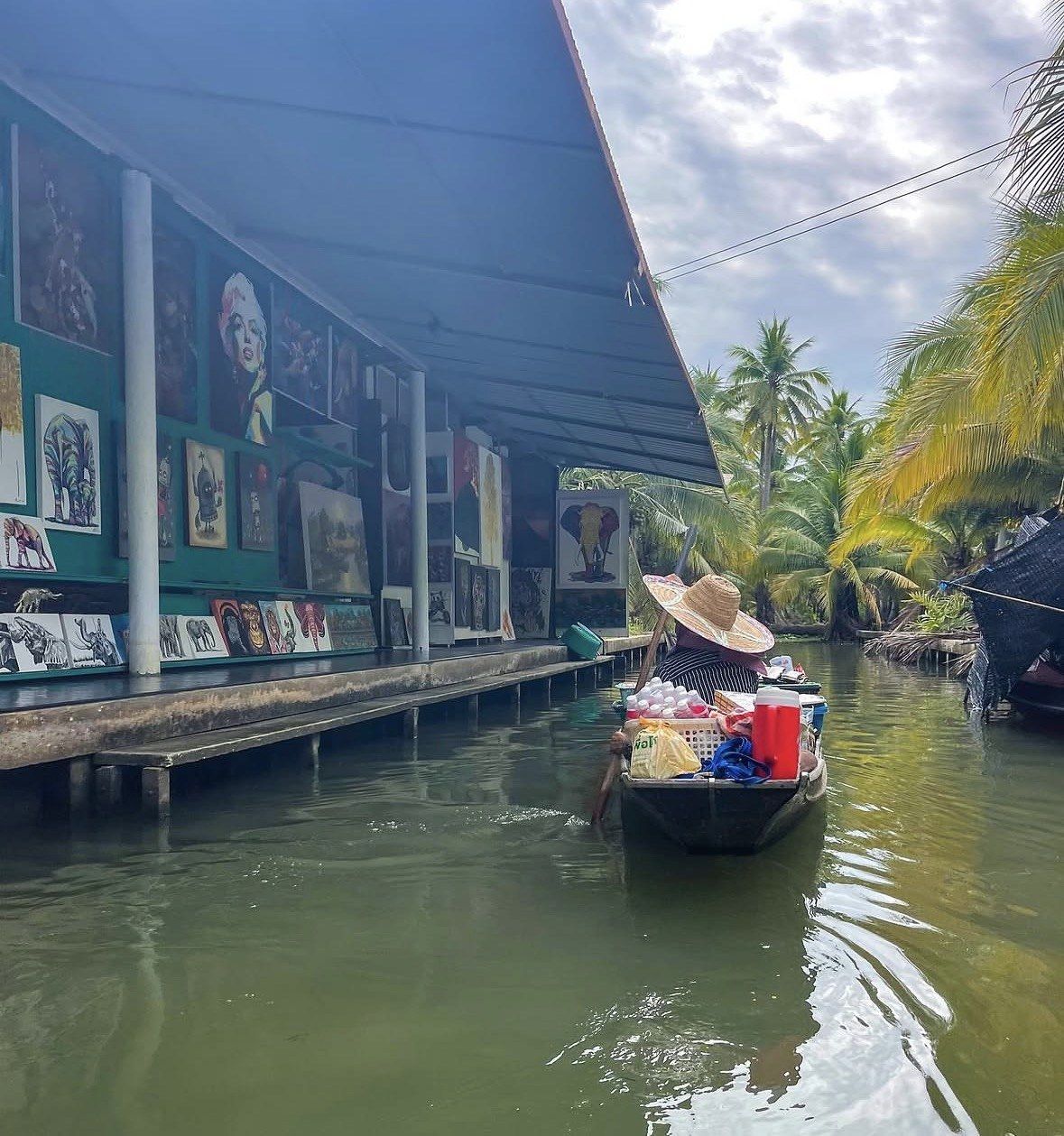
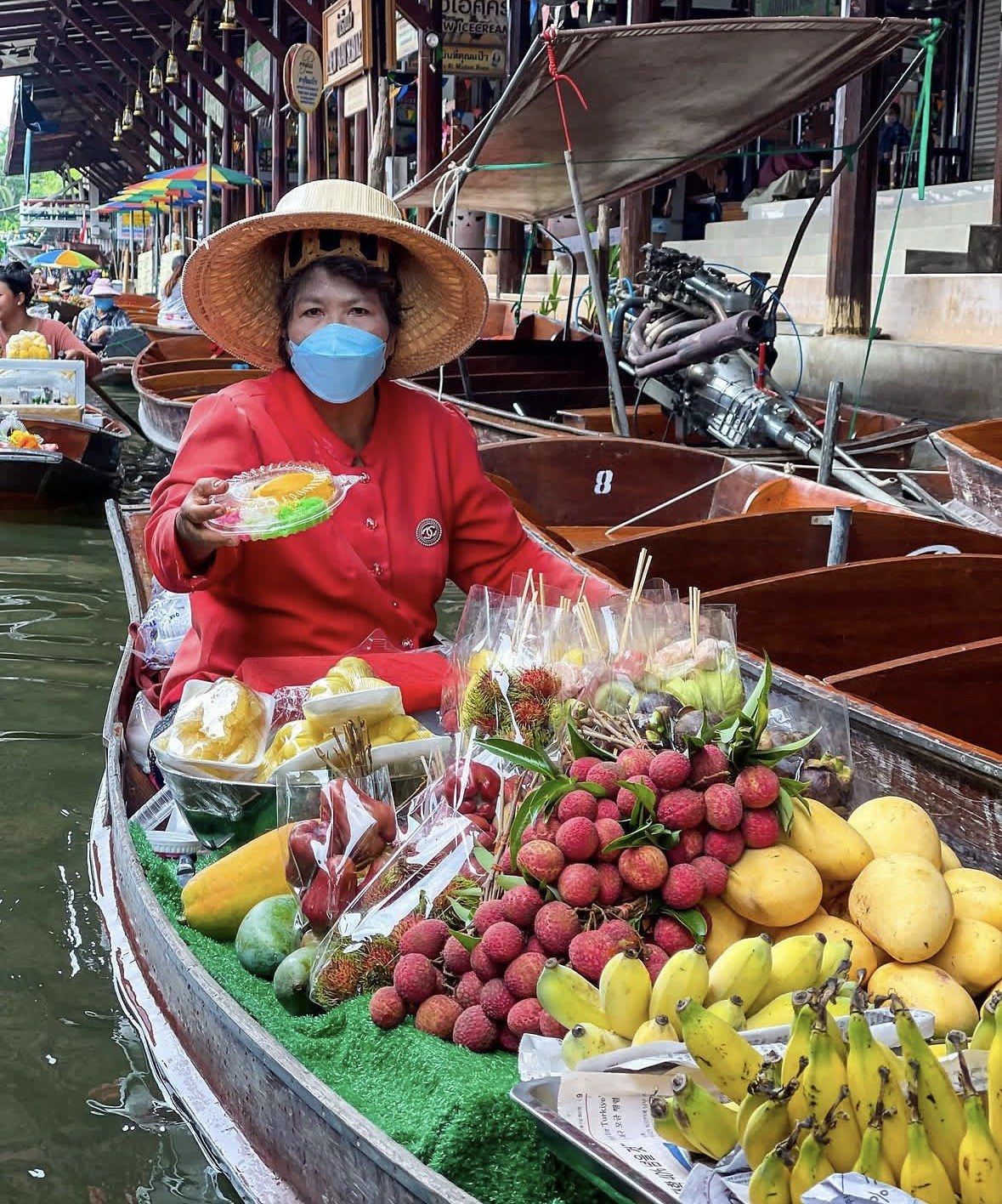
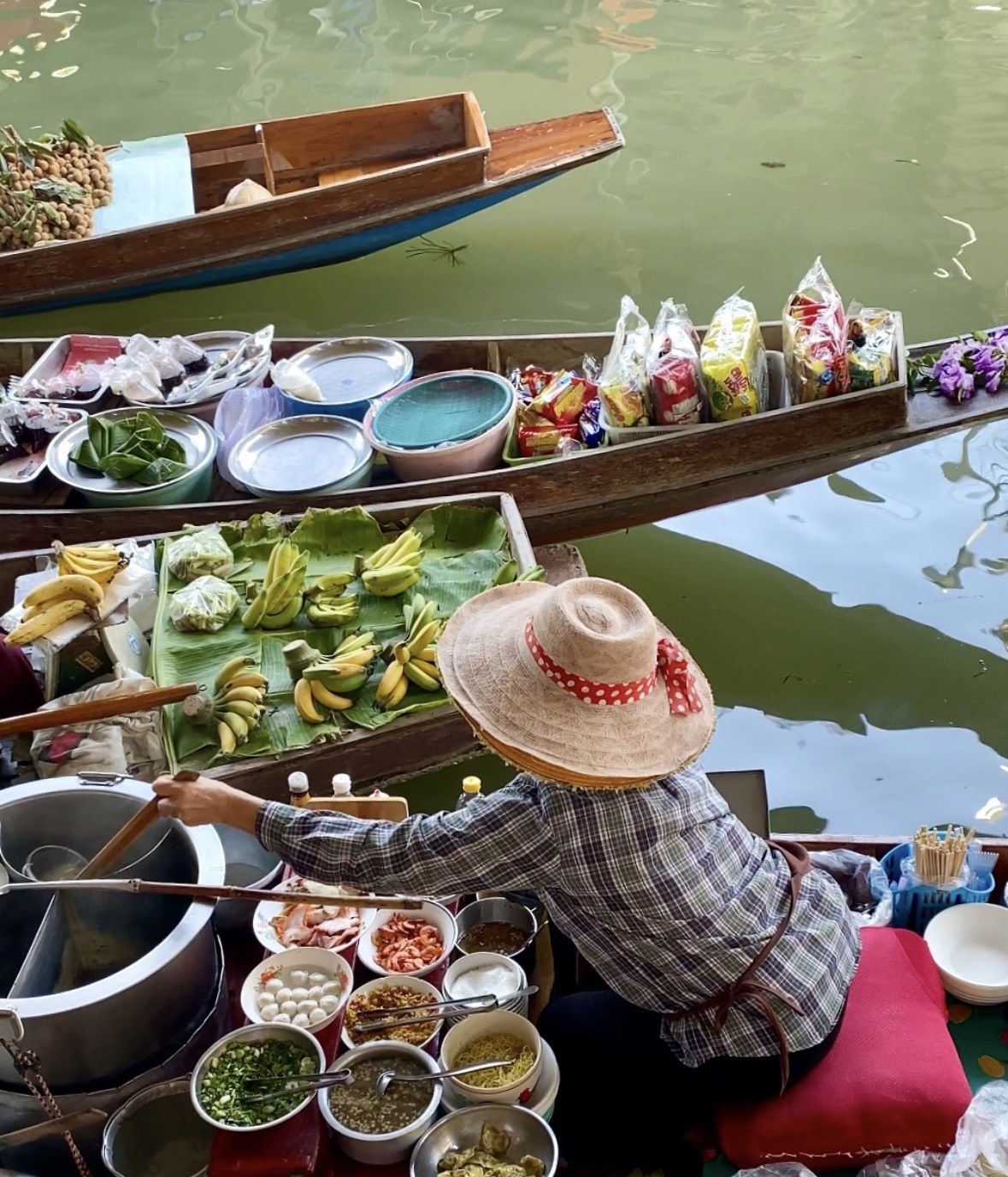
Damnoen Saduak is spread across three markets. The largest of them is Ton Khem; Hia Kui runs to souvenir shops stocked for coach parties; Khun Phitak, about 2 km south of Hia Kui, sees far less of that traffic. Selling happens from sampans, the small wooden boats, with cooks ladling boat noodles out of canoes. Food and souvenirs hold much the same price from stall to stall, within a few baht, at a level widely described as set for tour groups. The canal itself is engineering: King Mongkut ordered it cut to join the Mae Klong and Tha Chin rivers, the work was finished in 1868, and villagers later dug the roughly 200 side canals that now give you somewhere to go when the main stretch seizes up.
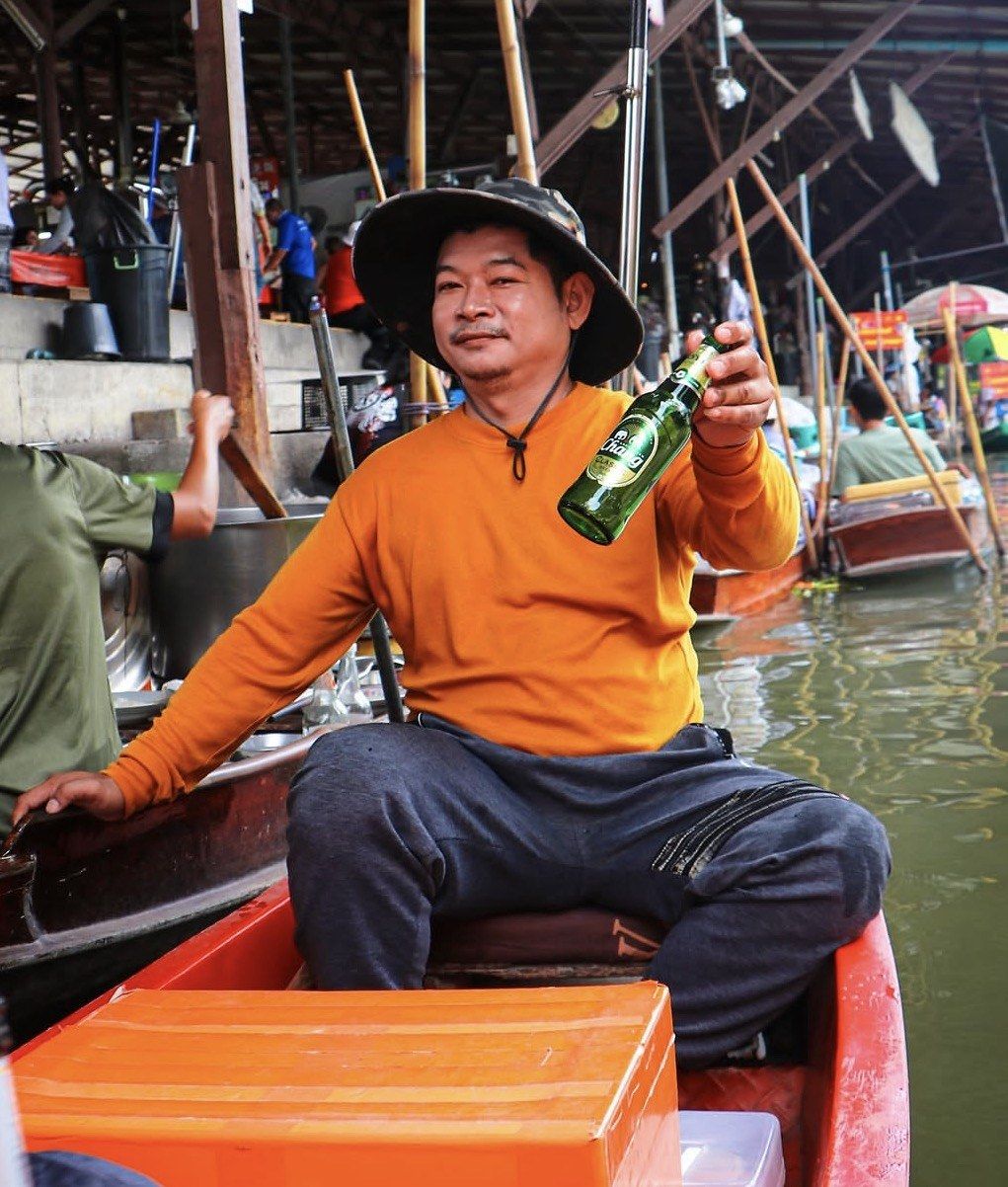
Amphawa trades on foot as much as on the water. The signature is seafood grilled on wooden boats moored around the central bridge and sold by weight; small food carts appear at weekends only. The rest of the eating runs through grilled river prawns, pad thai cooked in a boat, hoi tod oyster omelette, boat noodles, Mae Klong mackerel, coconut ice cream, khanom sweets and coconut-sugar desserts, with weekend extras like ice cream sandwiches and Yum Magda Talay, a helmet crab egg salad. Two canal circuits leave from counters by the bridge, a temple tour and an island tour, each about an hour; the shared boats wait until every seat is taken, so they cost time. Souvenirs from these canal communities are coconut sugar, dried fruit and snacks, handmade soaps, woven bags, herbal products and wooden crafts, and the sugar is still made by tapping palm sap morning and evening and boiling it down on a stove.
Fireflies are the Amphawa add-on, and they run on a season. The insects collect in the mangrove trees that line the Mae Klong, mostly through the rainy months of May to October, and one Thai study of Pteroptyx malaccae put the highest adult population in the September to November window. Larvae are most abundant 5 to 20 metres back from the water, so the display sits on the immediate riverbank fringe. Sightings are never guaranteed. A smaller, quieter boat is the one to take; ask for the engine to be cut as you come up on the trees and leave the flash switched off.
Can you visit Damnoen Saduak and Amphawa in one day?
Yes, but only from Friday to Sunday and only with a private car. The two sit about 14.4 km apart, roughly 15 minutes of driving, and the opposite trading hours are what make the pairing possible: one winds down around noon, the other opens at 2 pm. Shared tours do not combine them.
The cost is the length of the day. You leave Bangkok in the dark to be in a boat at Damnoen Saduak by 07:30, the useful part of that canal is behind you by 09:30, and then there are hours to fill before Amphawa opens. The gap goes to the railway market, open every day from 07:00 to 16:00, where the whole point is a train: the Ban Laem to Mae Klong branch brings only four a day, arriving at roughly 08:30, 11:10, 14:30 and 17:40, and the 11:10 is the arrival that fits neatly between the two floating markets. Wat Bang Kung, open daily 08:00 to 16:30 and about 8 minutes by taxi from Amphawa, takes another hour. One workable Friday-to-Sunday shape allows about 1.5 hours at the railway market, an hour at Wat Bang Kung, two hours at Amphawa and about 1.5 hours on the firefly boat, which puts you back on the road to Bangkok after dark on top of a pre-dawn start.
Skip the double unless you have your own car and a Friday, Saturday or Sunday to give it. On a weekday, take Damnoen Saduak with the railway market and be back in the city by early afternoon. On a weekend, give the day to Amphawa and the railway market and stay for the evening.
Which to choose, by traveller type
Damnoen Saduak suits anyone travelling Monday to Thursday, anyone who wants the canal photograph, and anyone whose day has to end by mid-afternoon. The difficulty is the departure. Being afloat by 07:30 means leaving Bangkok in the dark, which is the part a booked early start takes off your hands.
Choose Amphawa if food is the reason you travel, if you want the firefly boats in the rainy months, or if you would rather go out late than set a 05:00 alarm. The market trades year-round, but its own site recommends the dry season, November to March, when it is cooler and less humid. Bangkok's wetter stretch runs from 3 May to 28 October, which is also the firefly window, so the comfortable months and the firefly months pull in opposite directions.
- Travelling Monday to Thursday: Damnoen Saduak, paired with the Maeklong Railway Market. Day Trip to Bangkok Floating Market & Maeklong Railway, 9 hours, from THB 850, 4.9 ★ (1703 reviews), states 30 to 40 minutes in a boat once you are at the canal.
- Travelling Friday, Saturday or Sunday and after the afternoon-into-evening rhythm: Amphawa. Bangkok: Amphawa Float Market & Maeklong Railway Evening Tour, 8.5 hours, from THB 1420, 4.5 ★ (88 reviews), is built around the later start.
- First visit, with a canal full of boats as the image in your head: Damnoen Saduak, on the water by 07:30.
- Eating is the reason you are going: Amphawa, at a canal-side table before the bridge fills.
- Photographers: Damnoen Saduak's side canals in the first two hours of light, where orchards, stilt houses and working boats replace the souvenir stalls of the main stretch.
- Families with small children: the paddle boats at Damnoen Saduak do not carry life jackets sized for the very young, and adults stay responsible throughout.
- Anyone with mobility problems: long-tail boats are awkward to climb into and out of on both canal circuits, so settle that before committing to a boat.
- No appetite for two hours of road: Amphawa, at roughly half the distance, is the shorter of the two runs.
Questions people ask
Is there an admission charge at Damnoen Saduak or Amphawa?
No. Neither market charges you at a gate, and anyone demanding a fee to let you in is working a scam. If you are told a boat ticket is compulsory, you have been dropped at a private pier rather than the market: that is the standard taxi 'tour' move, with the driver stopping about 1 km short. Turn down the cheap private trips that drivers offer on the street.
Will I see fireflies if I pick Amphawa?
Maybe. Fireflies along the Mae Klong are usually visible in the rainy season, May to October, and a Thai study of the display species recorded the highest adult population from September to November. Dark nights are better than bright ones, and no operator can promise a show. If the fireflies are what you are travelling for, aim at September to November and pick a night without much moon.
What time of year suits these two trips best?
For Amphawa the official site names the dry season, November to March, as the cooler and less humid stretch. Set against that, the wet half of the Bangkok year covers 5.8 months, 3 May to 28 October, when any given day carries better than a 36 percent chance of rain; the extremes inside it are September, with 8.6 inches of rain across about 20 wet days, and August, rated muggy or worse on 31 days, while December drops to 0.9 wet days. Those two windows do not overlap, so decide which matters more before you book.
Is there a dress code for the temple stops on these itineraries?
Shoulders and knees covered. T-shirts, long trousers, maxi skirts and culottes all pass; uncovered tank tops or spaghetti straps, short shorts, mini skirts and see-through fabrics do not, and visitors who turn up short may be asked to rent or buy a cover-up. Shoes come off at the door of a temple hall, so wear something you can slip off without crouching. Amphawa itineraries in particular tend to include a temple where the code is enforced.
Which market is easier to reach without a car?
Amphawa, on distance alone, at about 50 km against 80 to 100 km for Damnoen Saduak. The market's own site routes visitors via BTS Bang Wa, then on to the Southern Bus Terminal at Sai Tai Mai, then a minivan, in as little as 90 minutes; minivans to Damnoen Saduak also leave Sai Tai Mai and take about two hours, but they do not stop at the two large car parks beside the market. For Damnoen Saduak, where the early window and the touts are the real obstacles, a booked tour with a fixed departure removes most of the friction.
Read also